
At a glance
- Medicare open enrollment runs October 15 through December 7, and changes take effect January 1.
- People in a Medicare Advantage plan get one more change between January 1 and March 31.
- Drug lists and Advantage networks change every year, and plan choices in rural Utah counties differ from those along the Wasatch Front.
- IRMAA is a surcharge on Part B and Part D premiums based on your income from two years earlier, and one dollar over a threshold triggers the full tier.
- After a qualifying life-changing event such as retirement or the death of a spouse, form SSA-44 asks Social Security to use a more recent, lower income.
Medicare open enrollment runs from October 15 through December 7, and the window for 2027 coverage is open now. Most of the attention goes to drug plans and networks. Less goes to the Medicare IRMAA surcharge, an extra premium for higher-income retirees set by tax decisions made two years earlier. Both are worth a fall review, and for many Utah retirees they meet in the same conversation about income.
Two minutesHow much of your retirement is actually decided?Get my Clarity ScoreWhat you can change between October 15 and December 7
During open enrollment, anyone with Medicare can:
- Switch from Original Medicare to a Medicare Advantage plan, or from Advantage back to Original Medicare.
- Move from one Advantage plan to another, with or without drug coverage.
- Join, drop or switch a stand-alone Part D drug plan if you have Original Medicare.
Changes take effect January 1. If you do nothing and your plan is still offered, it renews with the insurer’s changes for the new year. Those are listed in the Annual Notice of Change, mailed in September: next year’s premium, deductible, copays, drug list and network. It is the most useful document to read before December 7.
For 2027, Medicare limits out-of-pocket spending on covered Part D drugs to $2,400, up from $2,100 in 2026, and no plan can set a drug deductible above $700. A low-premium plan can still cost more over a year if your medications sit on a higher tier, so compare the estimated yearly cost rather than the premium alone.
The second window: January 1 to March 31
If you are in a Medicare Advantage plan on January 1, you get one more chance. Through March 31 you can switch to a different Advantage plan or leave Advantage for Original Medicare and add a stand-alone drug plan. Only one change is allowed, and it takes effect the first day of the following month. People new to Advantage get a similar three-month window once they have both Part A and Part B.
This period does not let someone in Original Medicare join an Advantage plan or switch stand-alone drug plans. Those changes wait for next fall unless a special enrollment period applies, such as a move out of your plan’s service area.
What to review in your plan each fall
Drug formularies. Insurers revise their drug lists every year. A preferred generic this year can move to a higher tier or drop off the list in January. Enter your prescriptions and pharmacy in the Medicare Plan Finder on Medicare.gov and compare the yearly estimate for each plan.
Advantage networks. Advantage plans are offered county by county, and networks change. Along the Wasatch Front, the usual question is whether a plan includes the health system and specialists you already see. In rural Utah the menu is shorter, and some rural counties have few or no Advantage plans open to individual enrollment. A retiree in Sevier or Sanpete County who sees specialists in Provo or Salt Lake City should confirm those providers are in network before choosing a plan built around a local clinic.
Time away from home. If you winter in St. George or out of state, note that many Advantage plans cover only emergency and urgent care outside their service area. Original Medicare works with any provider nationwide that accepts Medicare.
Free local help. Utah’s Senior Health Insurance Information Program (SHIP) offers free Medicare counseling by phone and in person. It is listed with the state Division of Aging and Adult Services and delivered by local aging agencies, such as Salt Lake County Aging and Adult Services. SHIP is federally funded and independent of insurance companies.
Medigap switches and Utah’s birthday window
Medigap supplement policies follow their own rules. The strongest federal protection is the six-month Medigap open enrollment period that starts the month you are 65 or older and enrolled in Part B. During it, an insurer cannot refuse you or charge more because of your health. Afterward, outside a few federal guaranteed-issue situations, insurers can generally use medical underwriting.
That matters if you are thinking of leaving an Advantage plan for Original Medicare this fall. The switch is allowed, but in most cases a supplement is not guaranteed, so it can be worth getting an answer on a supplement application before dropping the Advantage plan.
Utah added a narrower protection in 2025. Since May 7, 2025, a person who already has a Medigap policy gets a 60-day window each year, starting on their birthday, to move to a comparable or lower-tier plan from the same insurer without medical underwriting. It does not guarantee a policy from a different company, and it does not help someone coming from an Advantage plan.
How Medicare IRMAA is calculated
IRMAA, the income-related monthly adjustment amount, is set by Social Security, and nothing you choose during open enrollment changes it. It is based on modified adjusted gross income (adjusted gross income plus tax-exempt interest) from your tax return two years before the premium year. Premiums for 2026 are generally based on 2024 returns, those for 2027 on 2025 returns, and the income you report for 2026 will set your 2028 premiums.
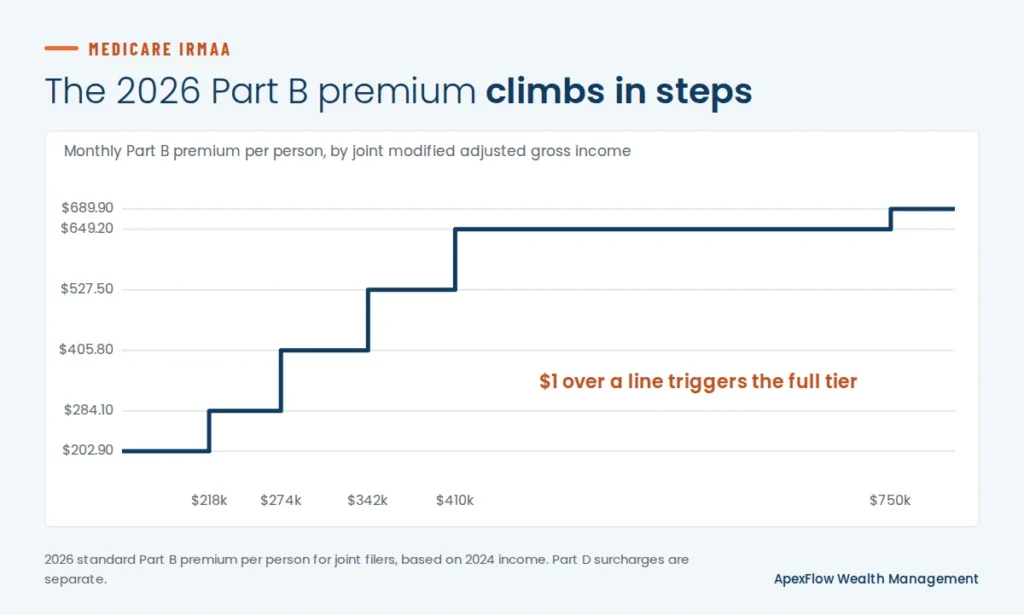
For 2026, the standard Part B premium is $202.90 a month and the Part B deductible is $283. The 2026 tiers, showing the monthly Part B premium and the Part D surcharge, are:
- Single up to $109,000, joint up to $218,000: $202.90 and none.
- Single over $109,000 to $137,000, joint over $218,000 to $274,000: $284.10 and $14.50.
- Single over $137,000 to $171,000, joint over $274,000 to $342,000: $405.80 and $37.50.
- Single over $171,000 to $205,000, joint over $342,000 to $410,000: $527.50 and $60.40.
- Single over $205,000 and under $500,000, joint over $410,000 and under $750,000: $649.20 and $83.30.
- Single $500,000 or more, joint $750,000 or more: $689.90 and $91.00.
The Part D surcharge is added to your plan’s premium, including drug coverage inside an Advantage plan, and is deducted from your Social Security benefit if you receive one. When both spouses have Medicare, each pays it. Married people who file separately and lived together during the year face much steeper tiers. CMS usually announces the next year’s figures in November, and the 2027 numbers had not been released as of late October 2026.
The cliff, and the income that crosses it
IRMAA tiers are cliffs. One dollar over a threshold triggers the full surcharge for that tier. For a married couple with joint income of $218,001 in the year that counts, the first tier adds $95.70 a month per person at 2026 rates (Part B and Part D surcharges combined), about $2,300 a year for the two of them.
The lower thresholds rise with inflation each year, but the income that crosses them usually arrives in lumps:
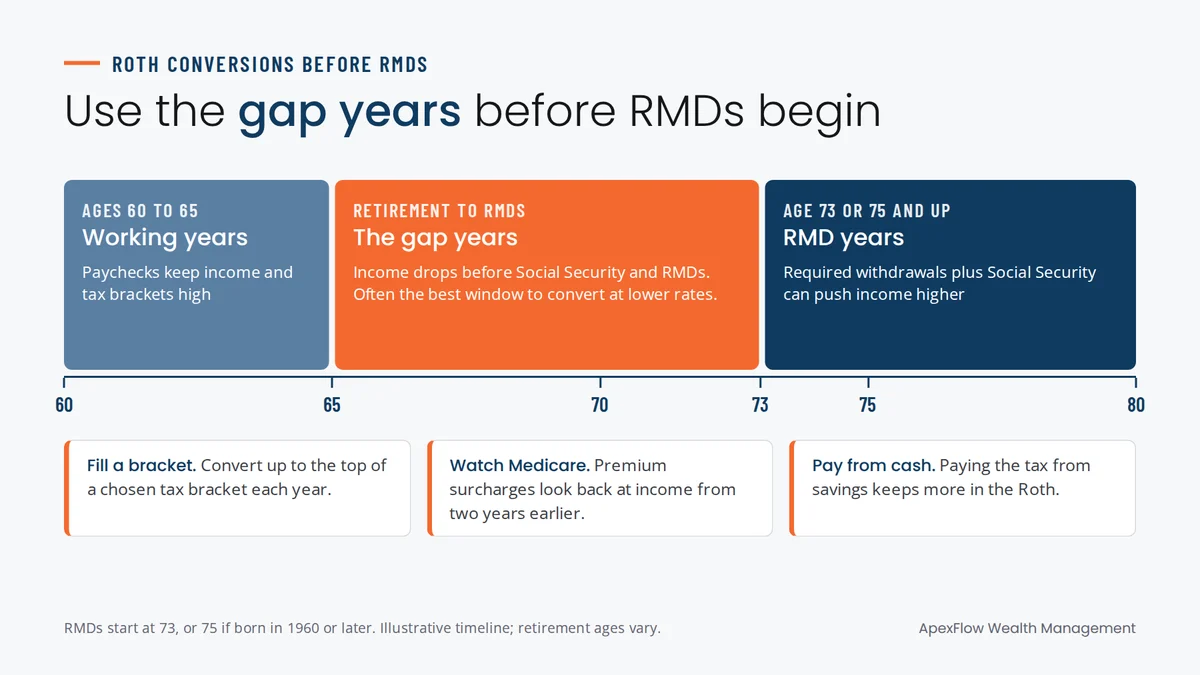
- Roth conversions. The converted amount is income in the year of the conversion.
- Required minimum distributions. RMDs begin at 73 or 75 and rise as a share of the account each year. Delaying the first one to April 1 puts two in one tax year.
- A business or home sale. Gain on a business sale counts, as does gain on a primary home above the federal exclusion ($250,000 single, $500,000 joint, if you qualify).
- Large capital gains. Selling a concentrated stock position or receiving a large fund distribution adds to income.
Managing the cliffs means managing the size and timing of income: spreading conversions over several years, sizing one to stop below a threshold, using qualified charitable distributions after 70½ so RMD dollars stay out of income, and realizing gains in lower-income years. Crossing a tier can still make sense when the tax saved later outweighs a year of surcharge. Our articles on Roth conversions before RMDs and the 2026 RMD rules cover both sides, and the year-end tax planning checklist lists items due by December 31. Coordinate these decisions with your CPA.
Hypothetical example: A retired couple in Sandy, both 67, expect 2026 joint income of about $150,000 from pensions, dividends and the taxable part of their Social Security. They want to convert part of a traditional IRA to a Roth before RMDs begin. A $100,000 conversion would put them near $250,000, inside the first IRMAA tier, adding about $2,300 to their combined 2028 premiums at 2026 rates. A $60,000 conversion keeps them near $210,000, below the 2026 joint threshold of $218,000, with a cushion because the 2028 brackets are not yet known. They plan to convert again in 2027. The figures are hypothetical and do not represent any client.
Asking Social Security to use a lower income
Because IRMAA looks back two years, it often arrives just as income has fallen. Retiring at 65 is a common case: your first premiums are based on a year of full salary. Form SSA-44 asks Social Security to use a more recent year, or an estimate of the current year, after a qualifying life-changing event:
- Marriage, divorce or annulment
- Death of a spouse
- Work stoppage or reduction, including retirement
- Loss of income-producing property, such as through a disaster or criminal fraud
- Loss or reduction of pension income
- An employer settlement payment
You can file online, by mail or at an appointment, with evidence such as an employer letter, a death certificate or a pension administrator’s letter. If you use an estimate, Social Security checks it against your tax return later.
A gain from selling property, an IRA conversion and the voluntary sale of income-producing property do not qualify, so a planned conversion will show up in premiums two years later. If the IRS data Social Security used is wrong, or you filed an amended return, you can ask for a correction. Our checklist after losing a spouse covers this request with the other first-year tasks, since a surviving spouse also moves from joint to single thresholds.
If you are new to Medicare
A few first-time points:
- Initial enrollment period. Seven months, from three months before the month you turn 65 to three months after it.
- Working past 65. If you or your spouse has group coverage through current work, you can delay Part B and sign up within eight months after that job or coverage ends.
- The Part B penalty. Missing your window adds 10 percent to the Part B premium for each full 12-month period you could have enrolled, usually for as long as you have Part B.
- HSA contributions. Contributions must stop once Medicare starts. Premium-free Part A can reach back up to six months when you sign up after 65, so Medicare’s guidance is to stop contributing six months before you retire. HSA money can still pay Part B, Part D and Advantage premiums tax-free, but not Medigap premiums. Our article on health savings accounts has more.
Where Medicare fits in the plan
Medicare premiums, including any IRMAA, belong in your retirement budget as a cost that moves with income. When we model Roth conversions, RMDs or a business sale through the Purposeful Planning Process, we show the premium effect two years out next to the tax.
Frequently asked questions
If you are in a Medicare Advantage plan, you can make one change between January 1 and March 31. Otherwise, changes generally wait until next fall’s open enrollment unless you qualify for a special enrollment period, such as after a move.
No. Social Security redetermines it each year from the tax return two years earlier, so a one-time spike in income raises premiums for about one year.
Yes. The converted amount is part of adjusted gross income in the year of the conversion, and Social Security does not treat a conversion as a life-changing event. Qualified Roth withdrawals later are not counted.
Utah’s Senior Health Insurance Information Program (SHIP) offers free one-on-one counseling by phone and in person through the state Division of Aging and Adult Services and local aging agencies. Counselors can help you compare plans in the Medicare Plan Finder.
Talk it through with us
Every situation is a little different. If you want to talk through yours, book a 20-Minute Fit Call with one of our advisors, by video or in person. No prep and no obligation. Want to see how we work first? Start with the Purposeful Planning Process or our services.

The information in this article is general in nature and is not a recommendation for any individual. Consider your own circumstances or speak with an advisor before acting on it. Any opinions are those of the author and not necessarily those of Raymond James.
ApexFlow Wealth Management does not provide tax or legal advice. Please consult your tax or legal professional before acting on any strategy mentioned here.
Examples labeled as hypothetical are for illustration only. They are not based on any actual client and do not represent actual or expected results.
Related Articles
Dig deeper into our resource library
-
 October 29, 2026
Year-End Tax Planning 2026: What Must Happen by December 31 and What Can Wait
Some 2026 tax moves must be finished by December 31 and others can wait until April 15, 2027. A dated checklist, plus how the new charitable, senior and SALT rules change the math this year.Read more -
 October 29, 2026
Required Minimum Distributions: The 2026 Rules and How to Reduce Them
RMDs start at 73 for most retirees today and 75 for younger ones. Here are the 2026 rules, the penalties, and the five ways to shrink the tax bill they create.Read more -
 November 5, 2026
Roth Conversions Before RMDs: Making the Most of the Gap Years
For many retirees, the years between leaving work and starting required minimum distributions are the lowest-tax years they’ll ever have. The paycheck has stopped, SocialRead more