

To get the full Intermountain 401(k) match, contribute at least the percentage of pay the match formula covers, reported at up to 4%, in every period the match is calculated. Caregivers leaving the pension also pick up a new 2% automatic contribution in 2027, which under the 2024 plan terms requires no contribution from you. Below we cover the 2%, the match, why maxing out early can cost you, vesting, the 2026 IRS limits and your T. Rowe Price settings.
ApexFlow Wealth Management is not affiliated with Intermountain Health. For the wider picture, start with our Intermountain pension freeze guide.
At a glance
- Intermountain’s pension stops growing after December 31, 2026, and caregivers who were still earning it move fully to the 401(k) in 2027.
- The 401(k) match is reported at up to 4% of pay, and the 2024 plan summary says a match is made only if you contributed for the same period.
- Under the 2024 terms, the automatic 2% contribution equals 2% of eligible pay and is generally credited at year end to caregivers employed when the last December payroll period begins.
- For 2026, the IRS limit on employee contributions is $24,500, plus $8,000 at age 50 or older or $11,250 at ages 60 to 63.
What changes in your Intermountain 401(k) in 2027?
Intermountain’s pension plan will be frozen on December 31, 2026, and affected caregivers will move fully to a 401(k)-based program, according to Intermountain’s announcement. Intermountain said part of the money freed up will fund a new 2% automatic 401(k) contribution, and that the 401(k) offers matching up to 4% (KSL).
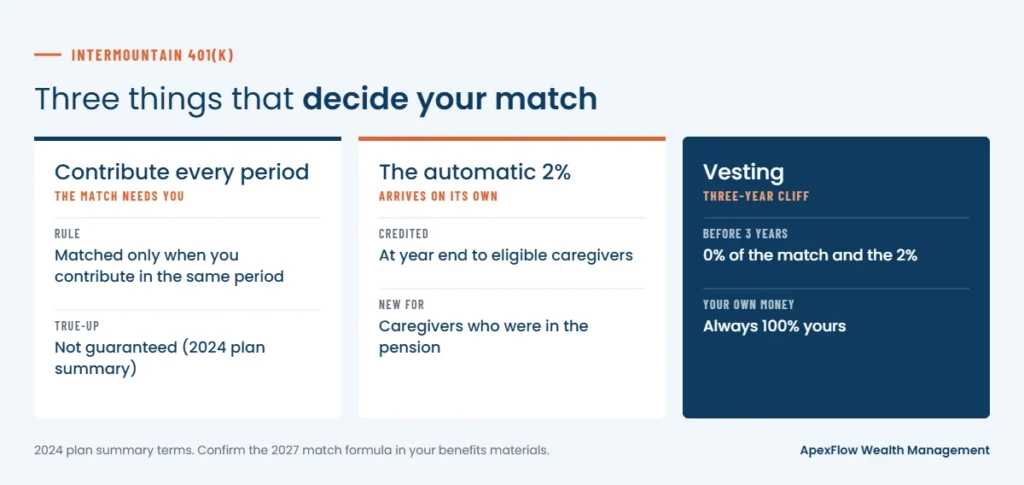
The 2% is new for pension caregivers, who could not receive it under the 2024 Intermountain Health 401(k) Plan summary (p. 10). Those terms define it as 2% of eligible pay for the plan year, credited as of the last business day of the year, for caregivers employed on the first day of the last payroll period ending in December. Caregivers who leave earlier because of a reduction in force, death or disability, or after age 55, still qualify.
The 2% arrives whether or not you contribute, but the match comes only from saving. Under these terms, a caregiver under 55 who leaves before that last December payroll period could miss the year’s 2%. Confirm the 2027 rules in your new benefits materials.
How much do you need to contribute to get the full match?
Intermountain has reported the match at up to 4% of pay, while the 2024 summary calls it discretionary and set as a percentage of eligible pay, with no formula stated (p. 11). “Up to 4%” could mean dollar for dollar on the first 4% you contribute, or a partial match on a larger contribution, and each version calls for a different rate. Confirm the 2027 formula in your benefits materials or with the Intermountain Retirement Program, whose contact details are on the retirees page.
Timing matters as much as the rate. The 2024 summary says the match is figured over a period Intermountain sets, such as a plan year, a calendar quarter or a payroll period, and that “matching contributions are only made if you have also made an elective contribution for the same time period.” True-ups, which make up a shortfall later, “are not guaranteed and are at the discretion of Intermountain.”
The summary also lets the plan limit matching for highly compensated employees (p. 12). The IRS threshold for that group is $160,000 for 2026 (IRS), so physicians and senior leaders should ask whether a limit applies.
Can maxing out your 401(k) early cost you match?
If the match is figured each paycheck and no true-up is made, it can. Once you reach the IRS limit, contributions stop and the match stops with them. Higher earners reach the limit soonest, so physicians who set a high rate in January are the most exposed.
Hypothetical example for illustration only. A caregiver under 50 earns $312,000 a year, paid in 26 paychecks of $12,000. We assume a match of 100% of contributions up to 4% of pay, figured each paycheck with no true-up, and we use the 2026 limit of $24,500 as a stand-in for 2027. The most match available is then $480 a paycheck, or $12,480 a year.
| Rate set for every paycheck | Your contributions for the year | Paycheck where the limit is reached | Match for the year | Match missed |
|---|---|---|---|---|
| 2% | $6,240 | Not reached | $6,240 | $6,240 |
| 4% | $12,480 | Not reached | $12,480 | $0 |
| 8% | $24,500 | 26 (the last) | $12,480 | $0 |
| 10% | $24,500 | 21 | $10,080 | $2,400 |
| 25% | $24,500 | 9 | $4,320 | $8,160 |
Here, 8% reaches the limit on the final paycheck and collects every match dollar. The 2% automatic contribution, $6,240 here under the 2024 terms, comes on top in every row because it does not depend on your rate. At 50 or older, catch-up room raises your ceiling, so ask whether catch-up contributions are matched.
When are you eligible for the match, and when is it yours to keep?
Under the 2024 summary, the match starts with your first paycheck on or after your first anniversary of employment (p. 11). Your own contributions are always 100% vested. Matching and 2% contributions accrued on or after April 1, 2023, vest on a three-year cliff, which means 0% before three years of vesting service and 100% after (p. 12). You also fully vest at 65 while employed, or if employment ends because of death or disability.
The pension closed to new caregivers in 2020, so most people still earning it are well past their first anniversary and have more than three years of service. Under the 2024 terms, their new match and 2% money would be fully vested when credited. If you had a break in employment or were rehired, confirm your vesting service with T. Rowe Price.
With less than three years, unvested money is forfeited at the earlier of a payout or 60 months after you leave (p. 14). If a departure date is on your mind, our guide to the five years before retirement covers the timing.
What are the 401(k) limits for 2026 and 2027?
For 2026, the IRS limits employee contributions to a 401(k) at $24,500. Caregivers 50 or older by year end can add up to $8,000 in catch-up contributions, and those turning 60 to 63 during the year can add up to $11,250 instead (IRS). Pay counted toward plan contributions is capped at $360,000 for 2026. Deferrals to Intermountain’s 403(b) plan or another employer’s plan count toward the same limit (p. 6).
The IRS announces each new year’s limits in the fall, and the 2027 limits had not been announced when we published. Once they are, recheck your rate so contributions last through the final paycheck. Our year-end tax planning checklist for 2026 covers the other December deadlines.
How do you check or change your rate at T. Rowe Price?
T. Rowe Price keeps the plan’s records. Use the “Log into your 401(k)” link on Intermountain’s retirees page, or call 1-800-922-9945, listed in the 2024 summary (p. 9).
- Find your current contribution percentage and the split between pre-tax and Roth.
- Change the percentage if your 2027 target is different. Under the 2024 summary, an election stays in place until you change it, so your current rate would carry into January unless your 2027 materials say otherwise.
- After your first 2027 paycheck, confirm on your pay stub and account that the contribution posted, then check the match once it is credited.
- At an Intermountain webinar or one-on-one retirement consultation, ask what matching period applies in 2027 and whether true-ups are made.
Pre-tax or Roth?
The plan allows both (p. 8). Pre-tax contributions lower your taxable pay now, and because Utah starts its income tax from federal adjusted gross income, they also lower Utah tax at the flat 4.45% rate for 2026. Roth contributions are taxed now, and qualified withdrawals, earnings included, come out tax free (IRS).
Starting in 2026, caregivers whose prior-year wages from Intermountain topped $150,000 must make any catch-up contributions as Roth. We walk through the Roth decision on our Intermountain pension freeze page, and compare the trade-offs in Roth vs. traditional IRA for high earners.
Where we fit in
Intermountain’s Retirement Program, webinars and benefits tool are the place to start for plan rules. As an outside second opinion, we look at how your 401(k) rate fits with the frozen pension, a spouse’s benefits, Social Security, Utah taxes and your other savings, and we coordinate with your CPA on tax questions. The rest of this series lives on our Intermountain pension freeze page, and you can see how we work in our planning process.
Frequently asked questions
Yes. Intermountain has reported its 401(k) match at up to 4% of pay, and the 2024 plan summary describes matching contributions as discretionary and set as a percentage of eligible pay. Confirm the 2027 formula in your benefits materials, because it decides how much you need to contribute.
Under the 2024 plan summary, it went to caregivers who were not eligible to earn pension benefits and who were employed on the first day of the last December payroll period, with exceptions for a reduction in force, death, disability or leaving after 55. With the freeze, Intermountain said the 2% comes to caregivers moving off the pension. It does not require a contribution from you under those terms.
It can happen. The 2024 plan summary says a match is made only for a period in which you also contributed, and true-ups are not guaranteed. If the match is figured per paycheck, contributions that stop in the fall stop the match too.
Under the 2024 terms, matching and 2% contributions vest on a three-year cliff, 0% before three years of vesting service and 100% after. Your own contributions are always fully vested. Most caregivers still earning a pension already have more than three years of service.
The IRS had not announced 2027 limits as of November 4, 2026. For 2026, the limit is $24,500, with an $8,000 catch-up at age 50 or older or $11,250 at ages 60 to 63.
Talk it through with us
If you’d like help choosing a 2027 401(k) rate that captures the full match and fits your household plan, we’d be glad to help. Book a 20-Minute Fit Call. It’s virtual, no prep is needed and there’s no obligation.

The information in this article is general in nature and is not a recommendation for any individual. Consider your own circumstances or speak with an advisor before acting on it. Any opinions are those of the author and not necessarily those of Raymond James.
ApexFlow Wealth Management does not provide tax or legal advice. Please consult your tax or legal professional before acting on any strategy mentioned here.
Investing involves risk, and you may incur a profit or loss regardless of the strategy selected, including diversification and asset allocation. Past performance does not guarantee future results.
Examples labeled as hypothetical are for illustration only. They are not based on any actual client and do not represent actual or expected results.
Related Articles
Dig deeper into our resource library
-
 October 29, 2026
Year-End Tax Planning 2026: What Must Happen by December 31 and What Can Wait
Some 2026 tax moves must be finished by December 31 and others can wait until April 15, 2027. A dated checklist, plus how the new charitable, senior and SALT rules change the math this year.Read more -
 November 5, 2026
Roth vs. Traditional IRA for High Earners: What to Do When You Earn Too Much
Retirement planning often sounds like it belongs in a different language. Acronyms everywhere. Rules buried in footnotes. And once your income climbs, the rules getRead more -
 November 5, 2026
The 5 Years Before Retirement: A Year-by-Year Planning Roadmap
Ask most people what their retirement plan is, and you’ll get one of two answers. Either a number, some version of “I need two millionRead more