

At a glance
- Sugar House combines older bungalows, new apartments, a busy commercial core and one of the city’s best parks. Demand is strong and prices reflect it.
- A primary residence in Utah is taxed on 55 percent of its value; confirm the residential exemption is applied when you buy.
- Utah’s flat income tax is 4.45 percent for 2026, which is a cut for most people arriving from the coasts and an increase for those from no-tax states.
- The S-Line streetcar, TRAX connection and bike routes make a one-car household realistic.
- A move is the best time to reset the whole plan: budget, emergency fund, estate documents, insurance and investment accounts.
Our office is at 1371 East 2100 South, in the middle of Sugar House, so we have a front-row view of the neighborhood and of the people moving into it. Young professionals come for the walkability and the restaurants. Families come for the park and the schools. Retirees downsize here from larger homes on the east bench.
Two minutesHow much of your retirement is actually decided?Get my Clarity ScoreThe neighborhood in brief
Sugar House sits southeast of downtown, roughly between 1300 East and 2300 East along 2100 South, with Highland Drive as its spine. The housing stock is a mix of 1920s to 1940s brick bungalows and Tudors on tree-lined streets, mid-century homes toward the east, and a wave of newer apartments and condos around the commercial core. Sugar House Park, 110 acres around a pond with views of the Wasatch, anchors the neighborhood. Westminster University is here, Interstate 80 is a few minutes away, and the S-Line streetcar connects to TRAX at Central Pointe.
It is one of the few neighborhoods in Utah where many residents walk to groceries, coffee, a movie and dinner. That is the appeal, and it is priced in.
Housing and what it really costs
Sugar House prices sit above the Salt Lake City average and well above the valley as a whole. Single-family homes trade at a premium for the location, and well-kept bungalows move quickly. Condos and townhomes near 2100 South offer a lower entry point.
For your budget, three Utah-specific items:
Property tax. A primary residence is taxed on 55 percent of its market value because of Utah’s 45 percent residential exemption. When you buy, make sure the county has the exemption applied to your parcel; if the previous owner rented the home out, it may not be. Salt Lake County reassesses annually, and taxes are due in November.
Older homes. Many Sugar House houses are approaching a century old. Budget for sewer lines, electrical, foundations and roofs. An inspection and a maintenance reserve of a few percent of the home’s value are not optional here.
Insurance. Homeowners insurance in Utah is moderate. Earthquake coverage is a separate policy, and the Wasatch Fault runs along the east side of the valley. Many homeowners here carry it; the premium is worth a conversation.
Utah taxes for a new arrival
Utah has a flat individual income tax, 4.45 percent for 2026, on wages, investment income and retirement income alike. For someone arriving from California, Oregon or New York, that is usually a meaningful reduction. For someone arriving from Texas, Washington or Nevada, it is a new cost to budget for. Utah does not tax Social Security for retirees under an income threshold thanks to a state credit, has no estate or inheritance tax, and taxes groceries at a reduced state rate.
If you are moving mid-year, you will file a part-year return in both states. Establishing Utah domicile clearly, with a driver license, voter registration, vehicle registration and updated estate documents, matters most if you are leaving a state with an aggressive tax department. Our article on Utah’s income tax for people moving from other states covers the comparison in more detail.
Commuting and transportation
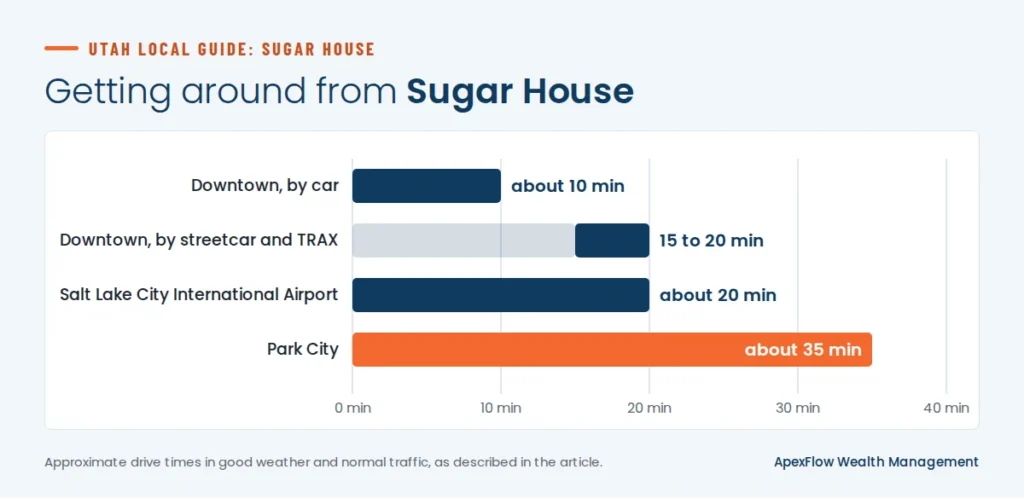
Sugar House is about ten minutes from downtown by car and fifteen to twenty by streetcar and TRAX. Interstate 80 puts the airport twenty minutes away and Park City about thirty-five. The S-Line, the Parleys Trail and a growing bike network make a one-car household practical, and the savings from dropping a second vehicle, often several hundred dollars a month, can fund a good share of a mortgage difference.
The moving checklist we use with clients
A move is a natural reset point. This is the list we use, roughly in the order of our Purposeful Planning Process.
- Define the why. What is the move for: shorter commute, walkability, proximity to family, downsizing? The answer shapes how much house to buy.
- Take inventory. New budget with Utah taxes, property tax, insurance and transportation. Emergency fund re-sized to the new housing cost.
- Housing decision. Rent for a year or buy now? Fixed or adjustable rate? How much of your net worth should sit in the home?
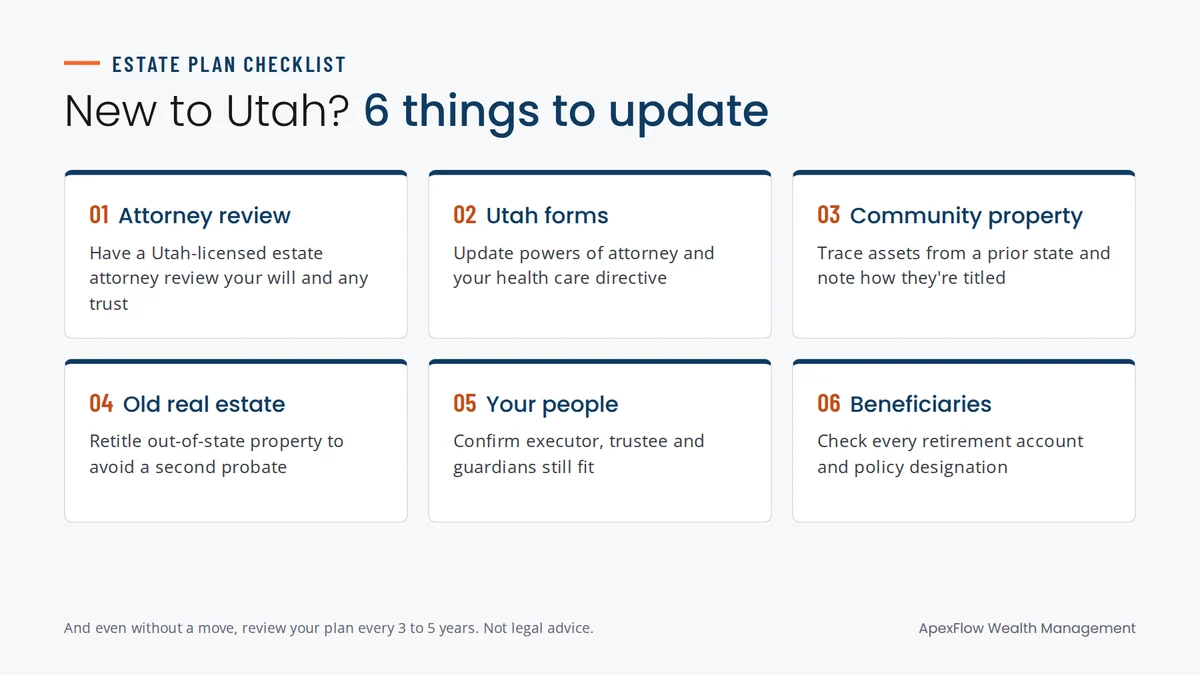
- Accounts and paperwork. New state on every account, updated beneficiaries, Utah estate documents, powers of attorney and a health care directive. See updating your estate plan after moving to Utah.
- Benefits and employer plans. If the move comes with a new job, review the 401(k) match, equity compensation, HSA and insurance elections together.
- Investments. Make sure the portfolio matches the new timeline. Cash needed for a down payment in the next two years does not belong in stocks.
Hypothetical example: A couple in their mid-30s relocates from Seattle for a job at a Salt Lake tech company. They rent a Sugar House apartment for a year while learning the neighborhoods, then buy a 1930s bungalow a few blocks from the park. Their plan sets aside a repair reserve for the older home, adds earthquake coverage, resets their emergency fund to six months of the new budget, and routes the state tax they now owe Utah into a line item. The husband’s new RSU grants are mapped on a vest calendar so each vest is a decision rather than a surprise. The example is illustrative only.
A neighbor’s offer
Since we are already here, meeting in person is easy. New residents usually want three things from us: a budget that reflects Utah, paperwork that is actually finished, and a plan that fits the reason they moved. Our Salt Lake City financial planning page has more on how we work.
Frequently asked questions
Relative to the rest of Salt Lake County, yes. Walkability, the park and the housing stock command a premium. Condos and townhomes near 2100 South are the more accessible entry point.
Utah exempts 45 percent of a primary residence’s value, so you are taxed on 55 percent. Confirm the exemption is on your parcel after purchase, especially if the home was previously a rental.
Renting for a year is a low-cost way to learn the neighborhoods, confirm the commute and avoid buying under time pressure, particularly if you are also starting a new job.
It is a separate policy and not required, but the Wasatch Fault runs along the east side of the valley and many homeowners choose to carry it. The decision depends on your home’s construction, your equity and your tolerance for the risk.
Free one-page checklist
Moving to Utah: your financial checklist. Every step from before the move through your first year, on one printable page.
Talk it through with us
Every situation is a little different. If you want to talk through yours, book a 20-Minute Fit Call with one of our advisors, by video or in person. No prep and no obligation. Want to see how we work first? Start with the Purposeful Planning Process or our services.

The information in this article is general in nature and is not a recommendation for any individual. Consider your own circumstances or speak with an advisor before acting on it. Any opinions are those of the author and not necessarily those of Raymond James.
ApexFlow Wealth Management does not provide tax or legal advice. Please consult your tax or legal professional before acting on any strategy mentioned here.
Examples labeled as hypothetical are for illustration only. They are not based on any actual client and do not represent actual or expected results.
Related Articles
Dig deeper into our resource library
-
 November 4, 2026
Retiring From Hill Air Force Base: A FERS and TSP Guide for Civilian Employees
Most Hill civilians retire under FERS, and the choices around the annuity, survivor benefits, health coverage and the TSP are permanent or close to it. What to know before you file.Read more -
 November 2, 2026
Utah’s Income Tax and What It Means for Retirees Moving From Other States
Utah’s flat tax is simple, but how it compares with your current state depends on what kind of income you have. Here is how Utah treats pensions, Social Security, retirement withdrawals and capital gains, and how to establish residency cleanly.Read more -
 November 5, 2026
Moved to Utah? Why Your Estate Plan Needs a Fresh Look
There’s a comforting myth about estate planning: that it’s a project with an end date. You meet with an attorney, sign the documents and checkRead more