
At a glance
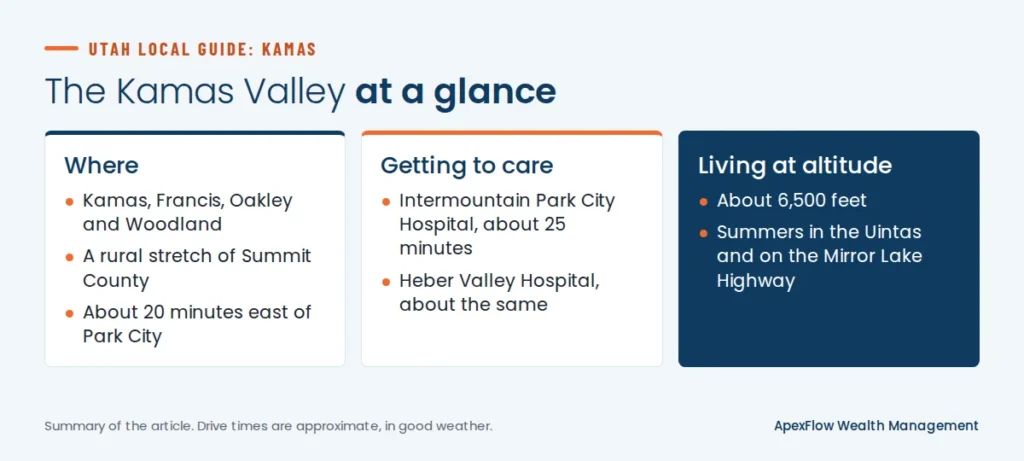
- Kamas, Francis, Oakley and Woodland make up the Kamas Valley, a rural stretch of Summit County 20 minutes east of Park City.
- Homes and land cost meaningfully less than in Park City, though prices have risen quickly as buyers look over the hill.
- Utah’s flat income tax, Social Security credit and lack of an estate tax apply the same here as anywhere in the state.
- Healthcare means Park City or Heber for hospitals and a longer drive to Salt Lake for specialists.
- Rural property adds wells, septic systems, water rights, snow and wildfire to the planning list.
Kamas is the kind of place people find by accident on the way to the Mirror Lake Highway and then cannot stop thinking about. A working ranching town with a Main Street, a rodeo arena and a view of the Uintas, it sits in the Kamas Valley with Francis, Oakley, Woodland and Peoa. Retirees come for space, quiet and mountains, at prices Park City left behind years ago. We work with clients across the Wasatch Back, and the money questions here are a little different from the ones in the valley.
Two minutesHow much of your retirement is actually decided?Get my Clarity ScoreWhat land and homes cost
The Kamas Valley is not cheap by Utah standards anymore, but it is a different market from Park City. Homes on larger lots, older farmhouses, newer builds in small subdivisions and acreage with water rights all trade at a fraction of comparable property twenty minutes west. The gap has narrowed as remote work and Park City prices pushed buyers over the hill, and new development around Francis and along State Route 32 has been steady.
Utah’s property tax rules favor full-time residents: a primary residence is taxed on 55 percent of its market value. Agricultural land in production may qualify for greenbelt assessment at a far lower value, with a rollback tax if the use changes. If you are buying acreage, understand which parcels are assessed how before you close.
Daily costs are modest. Kamas has a grocery store, hardware, restaurants and basic services. For anything more, Park City and Heber are a short drive, and most residents make a Salt Lake run every few weeks.
Rural property has its own line items
Many Kamas Valley homes are on wells and septic systems rather than municipal water and sewer. A well pump replacement, a septic inspection and periodic pumping are real costs. Water rights in Utah are separate property and must be verified in a purchase; a home with a well but no right to the water is a problem. Propane heat, snow removal on a long driveway, a truck or SUV with four-wheel drive and, increasingly, wildfire mitigation and insurance availability all belong in the budget. We have seen retirees surprised more by these than by the purchase price.
Taxes
Taxes in Kamas are Utah taxes: a flat 4.45 percent income tax for 2026 on pensions and retirement withdrawals, a credit that removes the tax on Social Security for many retirees, and no estate tax. Summit County property tax is where rural buyers should spend their attention, since greenbelt status and the primary residence exemption can change the bill a great deal. Our article on Utah’s income tax for retirees moving from other states covers the income side.
Getting to a hospital
Kamas has a family clinic for routine care. The nearest hospitals are Intermountain Park City Hospital, about 25 minutes, and Heber Valley Hospital, about the same. Both handle emergencies, surgery and imaging. Specialty care, cancer treatment and major cardiac work mean a drive to Salt Lake City of an hour or more, longer in winter. Ambulance response times are longer than in the valley. For a retiree with a chronic condition that requires frequent specialist visits, the distance is a factor to weigh honestly. Medicare Advantage networks should be checked for Summit and Wasatch County providers before enrolling.
Life at 6,500 feet
Winters are long and snowy, with Kamas sitting around 6,500 feet. Summers are the reward: the Uinta Mountains, Mirror Lake Highway, the Provo and Weber rivers, Rockport and Jordanelle reservoirs. The community is small and tight, with a county fair, a rodeo and high school sports as the social calendar. If you want quiet, you will find it. If you want restaurants and a symphony, they are in Park City and Salt Lake, and the drive is part of the deal.
Questions for a rural retirement
- Cash flow with a full rural budget. Property tax, insurance, propane, well and septic, snow removal, vehicles and the Salt Lake trips. Our retirement budget article is a starting point.
- Liquidity. Rural property can take longer to sell than a Park City condo. Keep more of the portfolio liquid if the home is a large share of net worth.
- Water and land. Confirm water rights, greenbelt status and any agricultural leases with the title company and the Division of Water Rights.
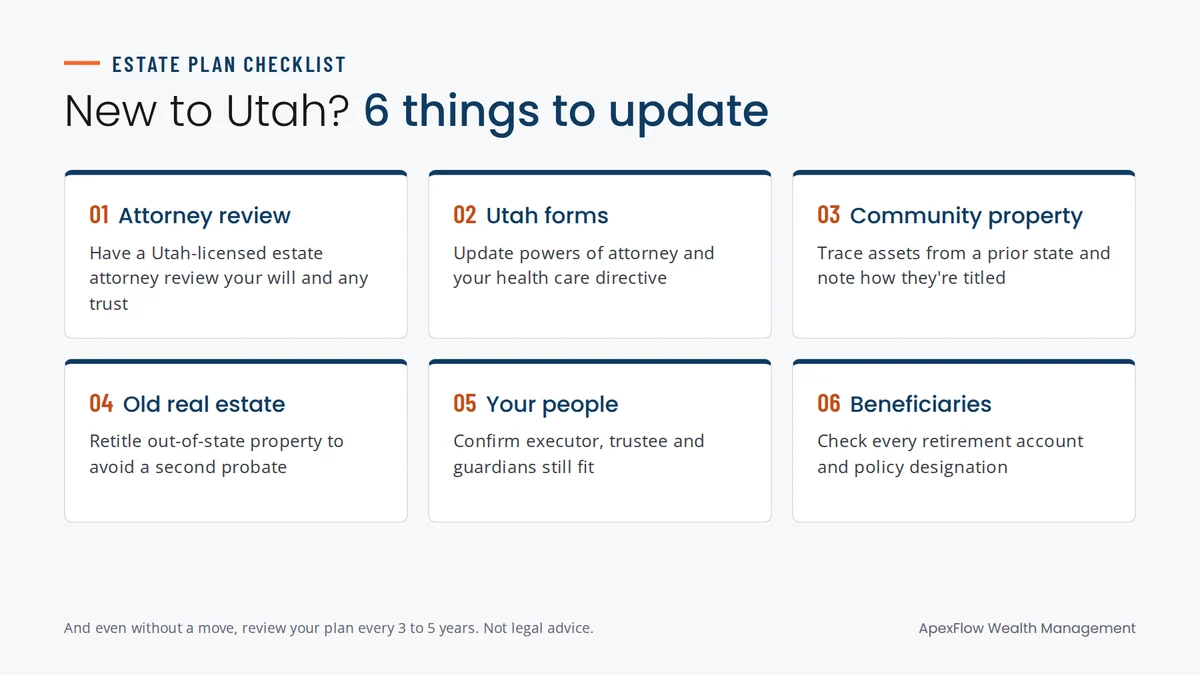
- Estate plan. Utah documents, and a trust that holds the property so it passes without probate. If you have land in another state too, a trust avoids two probates. See updating your estate plan after moving to Utah.
- Succession of the land. If you intend the property to stay in the family, our farm and ranch succession planning article applies even to a modest acreage.
Hypothetical example: A couple, 61 and 63, sell a home in Sandy and buy five acres with an older house near Oakley, paying cash and keeping a meaningful sum invested. The plan sets aside money for a new well pump, septic work and a truck, carries two years of spending in short-term bonds because the property could take time to sell, and builds the income plan around the husband’s pension while delaying Social Security. They choose traditional Medicare with a supplement so they can see Salt Lake specialists without network restrictions. The example is illustrative only.
Working with us from the Kamas Valley
Our Salt Lake City office is about an hour from Kamas, so most Wasatch Back clients meet us by video and come down when it suits them. A rural retirement has more moving parts than most, and we like to see the whole list, wells and water rights included, before we build the income plan. More on our approach is on the Salt Lake City financial planning page.
Frequently asked questions
Park City is about 20 to 25 minutes west on State Route 248. Salt Lake City is roughly an hour via Park City and Interstate 80, longer in winter weather.
Yes, meaningfully, though the gap has narrowed as buyers have moved east. You generally get more land and more house for the money, with fewer services nearby.
Water rights, well and septic condition, greenbelt assessment status, road maintenance and snow removal responsibilities, wildfire insurance availability and internet service.
Intermountain Park City Hospital and Heber Valley Hospital are each about 25 minutes away. Major specialty care is in Salt Lake City, about an hour.
Free one-page checklist
Moving to Utah: your financial checklist. Every step from before the move through your first year, on one printable page.
Talk it through with us
Every situation is a little different. If you want to talk through yours, book a 20-Minute Fit Call with one of our advisors, by video or in person. No prep and no obligation. Want to see how we work first? Start with the Purposeful Planning Process or our services.

The information in this article is general in nature and is not a recommendation for any individual. Consider your own circumstances or speak with an advisor before acting on it. Any opinions are those of the author and not necessarily those of Raymond James.
ApexFlow Wealth Management does not provide tax or legal advice. Please consult your tax or legal professional before acting on any strategy mentioned here.
Examples labeled as hypothetical are for illustration only. They are not based on any actual client and do not represent actual or expected results.
Related Articles
Dig deeper into our resource library
-
 November 2, 2026
Utah’s Income Tax and What It Means for Retirees Moving From Other States
Utah’s flat tax is simple, but how it compares with your current state depends on what kind of income you have. Here is how Utah treats pensions, Social Security, retirement withdrawals and capital gains, and how to establish residency cleanly.Read more -
 November 5, 2026
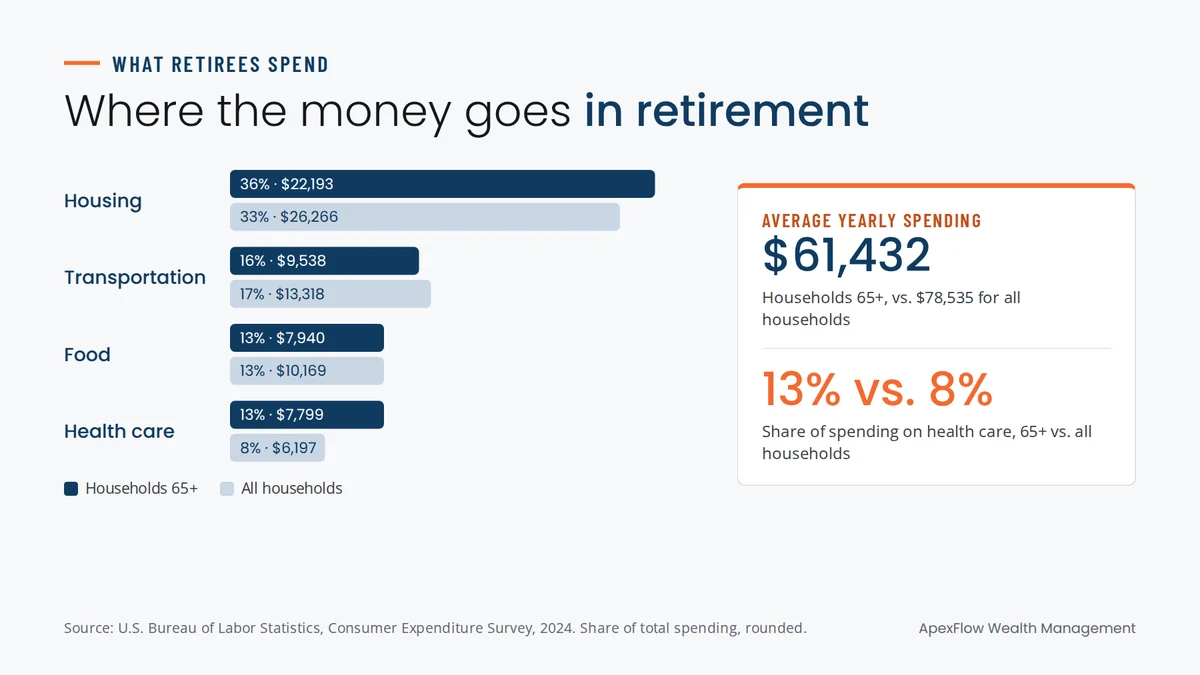
How to Build a Retirement Budget That Lasts
For decades, your budget had a built-in safety net: the next paycheck. Retirement changes that. Your income now comes from Social Security, maybe a pension,Read more -
 November 5, 2026
Moved to Utah? Why Your Estate Plan Needs a Fresh Look
There’s a comforting myth about estate planning: that it’s a project with an end date. You meet with an attorney, sign the documents and checkRead more