
At a glance
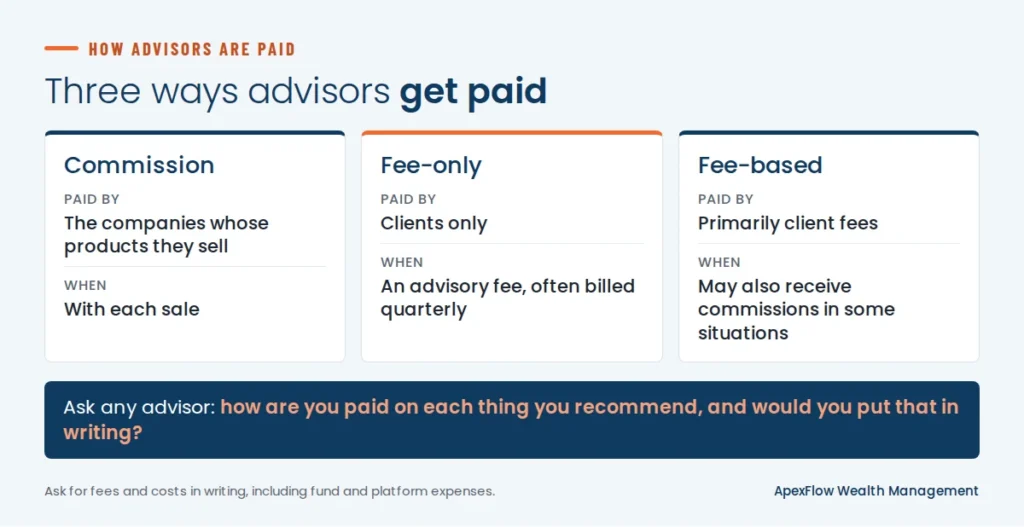
- Commission-based advisors are paid by the products they sell. Fee-only advisors are paid only by their clients. Fee-based advisors are paid primarily by client fees but may also receive commissions in some situations.
- Advisory fees are most often a percentage of the assets managed, billed quarterly, and the percentage usually declines as assets grow.
- The fee should buy a plan and ongoing advice, not just investment selection. Ask what is included.
- Fund expenses, trading costs and platform fees are separate from the advisory fee and should be disclosed in plain numbers.
- The right question is not “what do you charge?” but “how are you paid on each thing you recommend, and would you put that in writing?”
We think the way an advisor is paid should be the easiest thing to understand about working with them, and in practice it is often the hardest. The industry uses three similar-sounding labels that mean different things, and the differences matter because they shape the advice you get.
The three models
Commission-based. The advisor is compensated by the companies whose products you buy: a mutual fund with a sales load, an annuity, an insurance policy. You may pay nothing directly, but the cost is inside the product, and the advisor earns more when you buy more or buy certain products. This model is not inherently bad, and for someone who needs a single product and no ongoing advice it can be the least expensive route. The conflict is obvious, though: the advisor is paid to sell, not to advise.
Fee-only. The advisor is paid only by you, never by a product provider. Compensation may be a percentage of assets, a flat annual fee, an hourly rate or a project fee. No commissions of any kind. The conflict of interest is reduced, though not eliminated; an advisor paid on assets still has an incentive to keep your money under management rather than, say, paying off your mortgage.
Fee-based. This is the one that confuses people, because it sounds like fee-only. A fee-based advisor is paid primarily through fees charged to clients, typically a percentage of assets, but is also licensed to receive commissions and may do so in certain situations, most often for insurance or specific products that are not available in a fee account. Many advisors affiliated with a broker-dealer operate this way. The important thing is not the label but whether the advisor tells you, before each recommendation, which way they are being paid for it.
How we work
ApexFlow works primarily on an advisory fee basis: an ongoing fee for planning and investment management, calculated on the assets we manage for you, so our compensation rises and falls with your portfolio rather than with transactions. In a limited set of situations, for example certain insurance products, compensation may come as a commission, and we tell you in advance when that is the case and why. We put how we are paid in writing before you commit to anything, and we answer the question directly in our 20-Minute Fit Call. Our services page has a short FAQ on fees as well.
How an asset-based fee is calculated
The most common structure is a percentage of the assets under management, billed quarterly, with the percentage stepping down as the account grows. The exact percentage varies across the industry by firm, service level and account size, and it is always something you should see in writing before you sign.
What that fee should include is the better question. At a planning firm, the fee covers the financial plan and its updates, investment management, tax-aware decisions like asset location and loss harvesting, coordination with your CPA and attorney, and the ability to call when something happens. At a pure investment manager, it may cover only the portfolio. Two advisors quoting the same percentage can be delivering very different things.
Costs that are not the advisory fee
The advisory fee is one layer. Underneath it are the expenses of the investments themselves, usually expressed as an expense ratio on each fund or ETF, and any trading, custody or platform fees. A well-built portfolio keeps those low. A reasonable advisor will show you the total: advisory fee plus weighted fund expenses plus any other charges, as one number. If someone cannot or will not produce that number, that tells you something.
The questions to ask any advisor
- Are you a fiduciary when you give me advice, and in writing?
- How are you paid on this specific recommendation: fee, commission or both?
- What is my all-in cost, including fund expenses, as a percentage and in dollars?
- What is included in the fee beyond managing investments?
- Does your compensation change if I pay off debt, buy a house or take money out?
- Can I see your Form ADV, and will you walk me through the conflicts it discloses?
Every registered investment adviser files a Form ADV that describes services, fees and conflicts in plain language. It is public, and reading Part 2A before a first meeting is a reasonable thing to do. Our article on your first meeting with a financial advisor covers what else to bring.
Why we think the model matters less than the conversation
A fee-only advisor can give poor advice. A fee-based advisor can give excellent advice. What protects you is an advisor who explains how they are paid before you ask, who shows you the full cost, who tells you when a recommendation benefits them, and who is willing to say that the best move for you is one that pays them nothing. That is the standard we hold ourselves to, and it is why we talk about fees in the first meeting rather than leaving them for a signature page. If the way we work sounds right, our about us page introduces the team behind it.
Frequently asked questions
No. Fee-only advisors receive compensation solely from clients. Fee-based advisors are paid primarily by client fees but may also receive commissions in some situations. Ask which applies to each recommendation.
It aligns the advisor’s pay with your portfolio’s growth and keeps advice available without a bill for each call. It can be a poor fit for someone with a large portfolio and simple needs, or a small portfolio and complex needs, which is why some firms also offer flat or hourly arrangements.
Yes. The advisory fee pays the advisor; fund expense ratios pay the fund manager. A good advisor keeps the second layer low and shows you both together.
A fiduciary must act in your best interest and disclose conflicts. Registered investment advisers are fiduciaries when providing advice. Ask any advisor to confirm in writing that they act as a fiduciary for your account.
Talk it through with us
Every situation is a little different. If you want to talk through yours, book a 20-Minute Fit Call with one of our advisors, by video or in person. No prep and no obligation. Want to see how we work first? Start with the Purposeful Planning Process or our services.
The information in this article is general in nature and is not a recommendation for any individual. Consider your own circumstances or speak with an advisor before acting on it. Any opinions are those of the author and not necessarily those of Raymond James.
Investing involves risk, and you may incur a profit or loss regardless of the strategy selected, including diversification and asset allocation. Past performance does not guarantee future results.
Related Articles
Dig deeper into our resource library
-
 October 29, 2026
Alternatives and Private Investments: Who They’re For
Private credit, private equity and real estate funds are being marketed to more investors than ever. Here is what they are, what they cost you in liquidity and complexity, and who they actually suit.Read more -
 October 29, 2026
How We Think About Rebalancing
Rebalancing is the least exciting thing we do for a portfolio and one of the most important. Here is what it is, why we use bands instead of dates, and how taxes change the approach.Read more -
 November 5, 2026
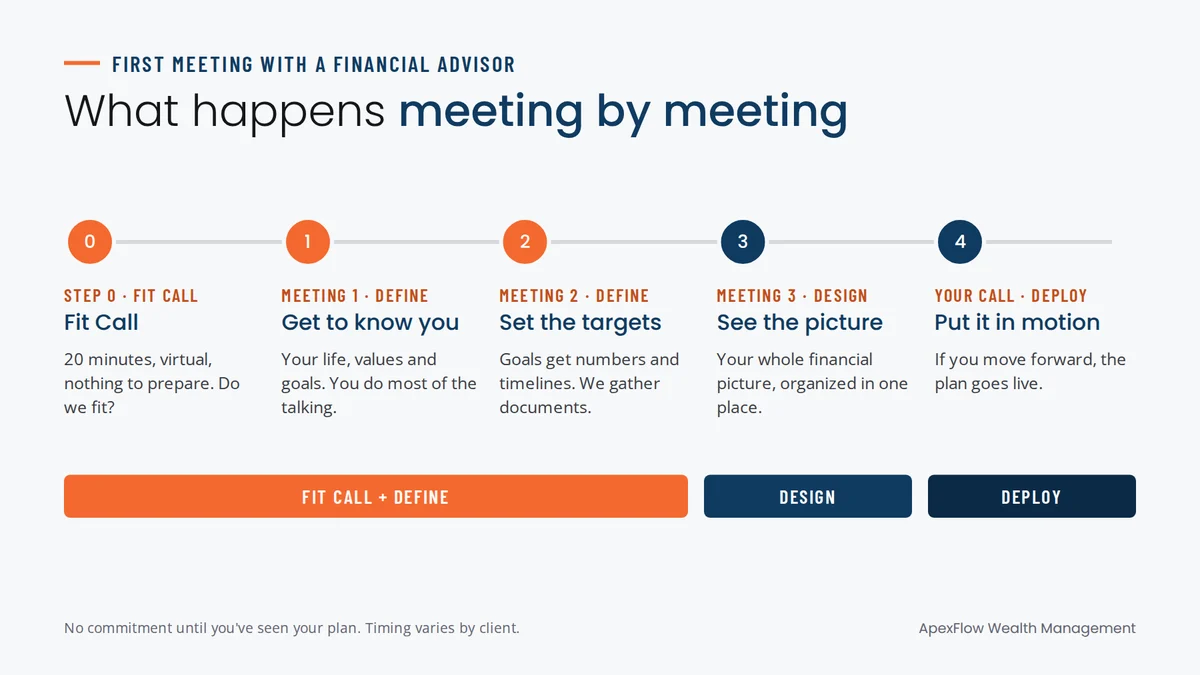
What to Expect in Your First Meetings With a Financial Advisor
Most people put off calling a financial advisor for the same reason they put off calling a doctor. It’s not that they don’t care. It’sRead more