
A market drops 3% in a week and it feels like the beginning of something bad. A market climbs 3% in a week and it barely registers. That imbalance isn’t a coincidence, and it isn’t a personal flaw. It’s called loss aversion: the tendency to feel losses far more sharply than gains of the same size. Understanding loss aversion in investing won’t make a market downturn painless, but it can change how you respond the next time volatility shows up.

At a glance
- Losses tend to feel about twice as strong as equal gains, which makes every market drop feel bigger than it is.
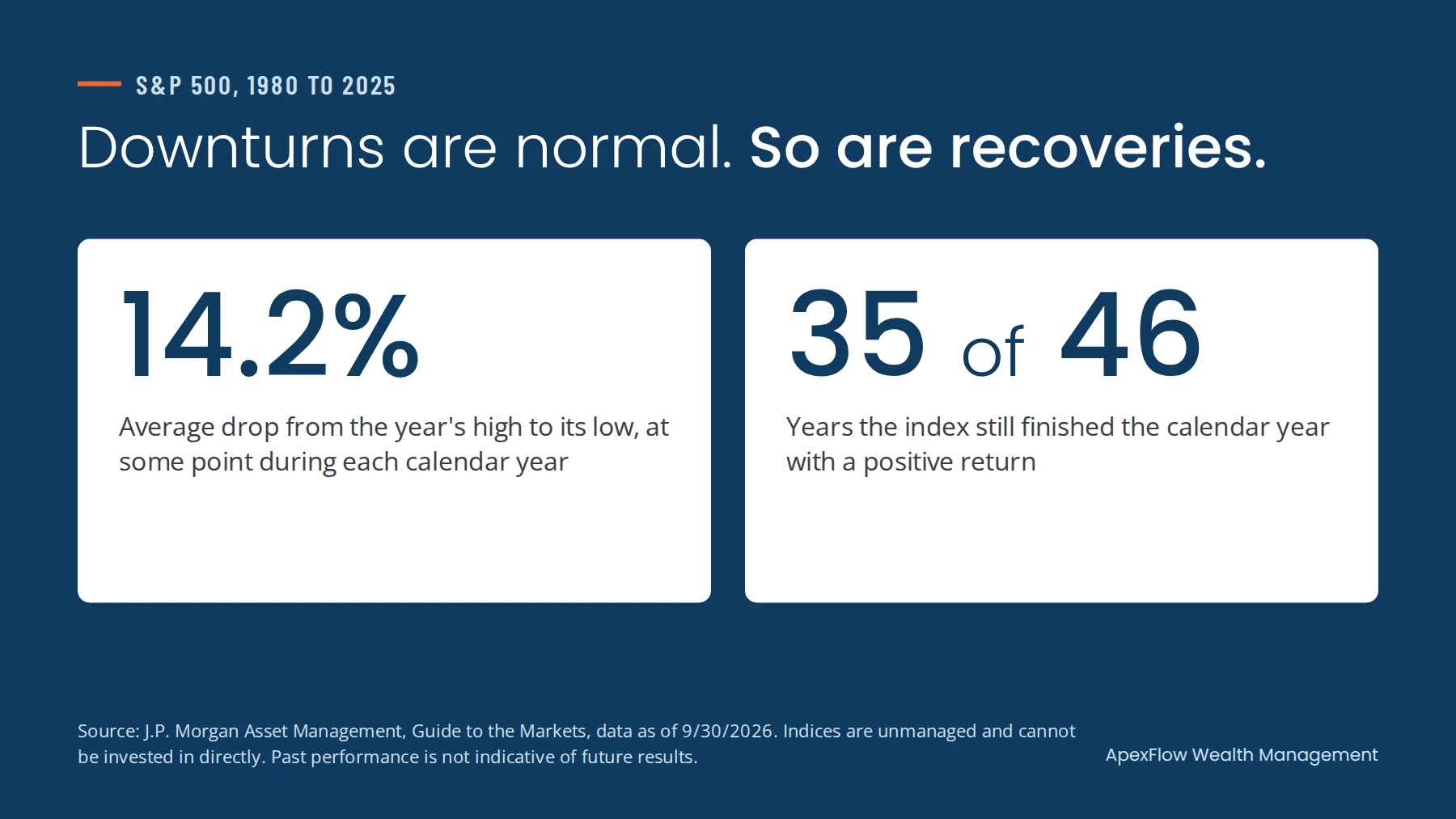
- Pullbacks are a normal part of investing. Since 1980 the S&P 500 has dropped an average of 14.2% at some point each year, yet finished positive in 35 of 46 years.
- The fix isn’t ignoring the feeling. It’s having a plan that already expects declines, so fear of losses doesn’t make the decision for you.
What is loss aversion?
Loss aversion is one of the best-documented ideas in behavioral finance. Psychologists Daniel Kahneman and Amos Tversky described it in 1979 as part of prospect theory, work that later helped earn Kahneman a Nobel Prize. Their finding was simple: losses loom larger than gains.
In one of Kahneman’s well-known examples, people offered a coin flip where they could lose $10 typically wanted the chance to win more than $20 before they’d take the bet (Schwab Asset Management). In other words, the pain of a loss tends to feel roughly twice as strong as the pleasure of an equal gain.
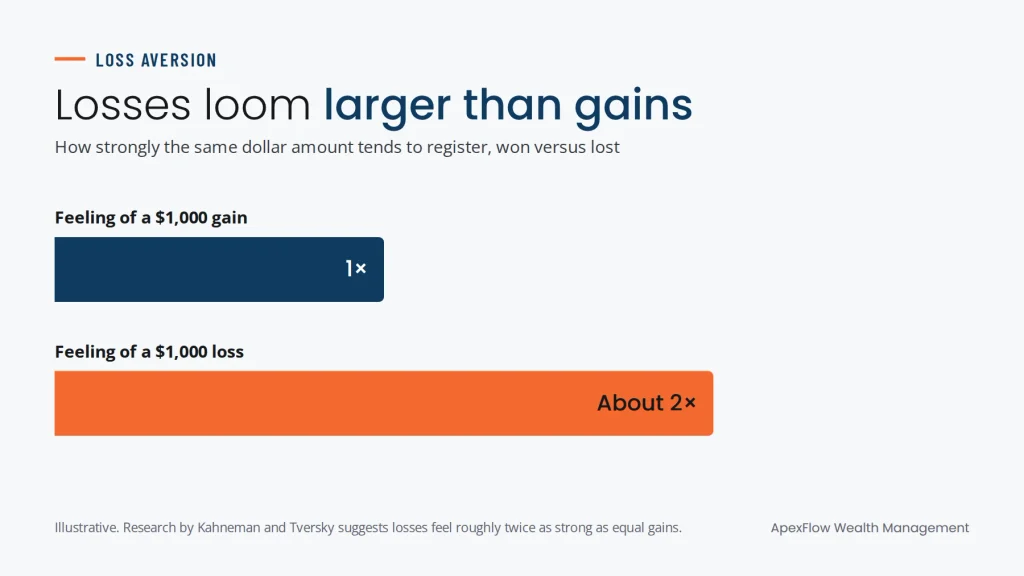
A loss and a gain of the same size are mathematically identical. Emotionally, they aren’t. That gap is a big part of why market declines feel so much more alarming than they usually are.
How loss aversion shows up in investing
Fear of losses rarely announces itself. It usually looks like a reasonable decision in the moment:
- Selling after a drop. Getting out “until things settle down” turns a temporary decline into a permanent loss, and leaves you deciding when to get back in.
- Sitting in cash too long. After a scare, it’s tempting to wait for the “right time” to reinvest. Recoveries often happen before that moment feels safe.
- Holding losers to avoid admitting a loss. The flip side of loss aversion: keeping an investment that no longer fits, because selling would make the loss feel real. Researchers call this the disposition effect.
- Checking constantly. Watching your account every day during a sell-off makes the losses feel bigger and more frequent, which makes every other mistake on this list more likely.
Why checking your portfolio makes downturns feel worse
There’s a second effect layered on top of loss aversion. Economists Shlomo Benartzi and Richard Thaler called it myopic loss aversion: the more often you evaluate your investments, the more often you see a loss, and the more painful investing feels.
Over a single day, markets fall almost as often as they rise. Over longer stretches, the long-term trend has more room to show through the noise. So the same portfolio can feel risky to someone checking it daily and steady to someone reviewing it a few times a year. And because most people check more often when markets are rough, their sense of risk gets skewed toward the worst moments.
What market history says about downturns
Here’s the part that tends to surprise people: pullbacks aren’t rare exceptions. They’re a normal, recurring feature of investing in stocks.
According to J.P. Morgan’s Guide to the Markets, from 1980 through 2025 the S&P 500 fell an average of 14.2% from its high to its low at some point during each calendar year. Despite those drops, the index finished the year with a positive return in 35 of those 46 years.
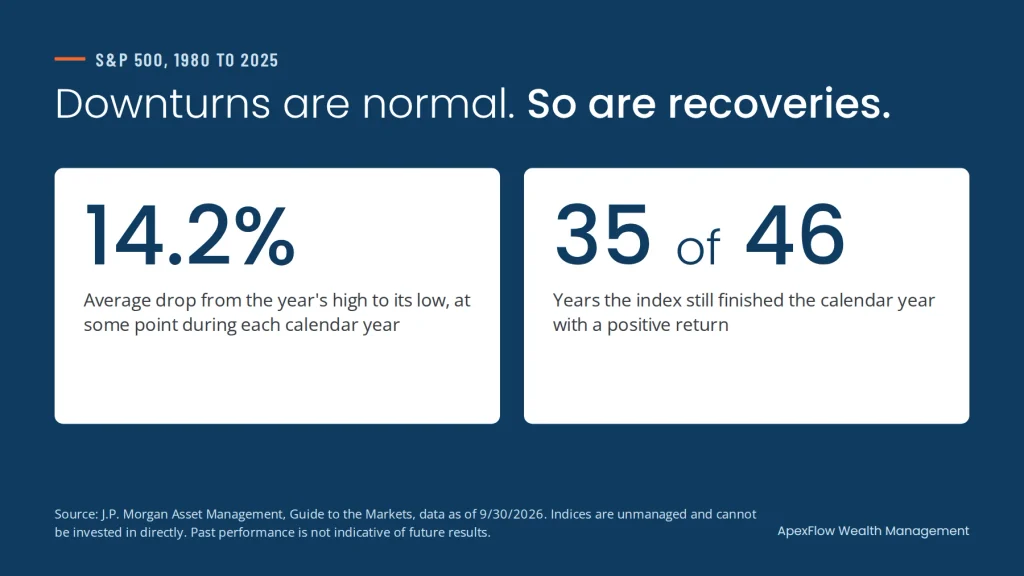
In other words, the dip that feels alarming in the moment usually isn’t a break from the normal pattern. It is the normal pattern.
This is historical index data shown for illustrative purposes only. Indices are unmanaged and cannot be invested in directly, and past performance is not indicative of future results.
Why it still feels different when it’s your money
Knowing the statistics doesn’t automatically make a downturn feel comfortable, and that’s worth acknowledging honestly rather than dismissing. There’s a real difference between reading about historical volatility and watching your own account value fall in real time.
The goal isn’t to convince yourself the discomfort is irrational. It’s to recognize it for what it is: a predictable, shared human response, not a signal that something has gone wrong with your plan.

Loss aversion near and in retirement
There’s one situation where fear of losses deserves a closer look instead of a pep talk: when you’re about to retire or already drawing income from your portfolio.
A 14% decline matters less to someone who won’t touch the money for 15 years than to someone who needs to sell investments next month to pay the bills. That isn’t loss aversion. It’s a real limit on how much risk your plan can absorb, and we explain the difference in Risk Tolerance vs. Risk Capacity in Retirement.
The answer usually isn’t to abandon stocks altogether, a move we look at in Why Time in the Market Beats Timing the Market. It’s to make sure the money you’ll need soon isn’t the money exposed to a downturn.
How to keep loss aversion from making your decisions
A few habits consistently help investors keep perspective when markets are falling:
- Check less often during volatile stretches. Frequent checking amplifies the emotional hit without giving you useful information.
- Revisit your time horizon. Money you don’t need for another 15 years is in a very different position from money you need next year.
- Keep a cash reserve. Having near-term spending set aside means a downturn doesn’t force you to sell. See How Much Should You Keep in Cash Reserves?
- Decide your rules before the storm. A plan that already says how you’ll rebalance and what would actually trigger a change is much easier to follow than a decision made mid-panic.
- Watch for the opposite bias too. After a strong run, the urge to chase what just went up is its own trap, which we cover in Why Chasing Last Year’s Winners Usually Backfires.
- Talk before you act. A second opinion from someone who knows your plan is often the difference between a reaction and a decision.
A plan built with volatility already anticipated is doing exactly what it was designed to do when volatility shows up. It’s not failing. It’s functioning.
Where we fit in
Part of our role isn’t just building the portfolio. It’s being the steady presence when that portfolio is doing what markets normally do. We’d rather have the honest conversation about what volatility looks like before it happens, so when it does, it feels recognizable instead of alarming. That conversation is built into the Define and Design stages of our planning process.
Frequently asked questions
Selling a fund after it drops 15% to stop the pain, even though nothing about your goals or the fund has changed, is a classic example. So is refusing to sell a poor investment because selling would make the loss feel real.
No. Caution about losses is healthy when it reflects a real need, like money you’ll spend soon. It becomes a problem when the feeling, rather than your plan, decides what you do.
There’s no single right answer, but checking daily during a downturn usually adds stress without adding information. Many investors do better with scheduled reviews tied to their plan, plus a conversation with their advisor when something in their life changes.
It depends on your situation, and it’s worth talking through before acting. Moving to cash locks in the decline and means you have to decide when to get back in. Recoveries often begin before the news improves, so timing both moves well is difficult.
Very common. From 1980 through 2025, the S&P 500 dropped an average of 14.2% at some point during the year, according to J.P. Morgan, yet still ended the year higher in 35 of 46 years. Past performance does not guarantee future results.
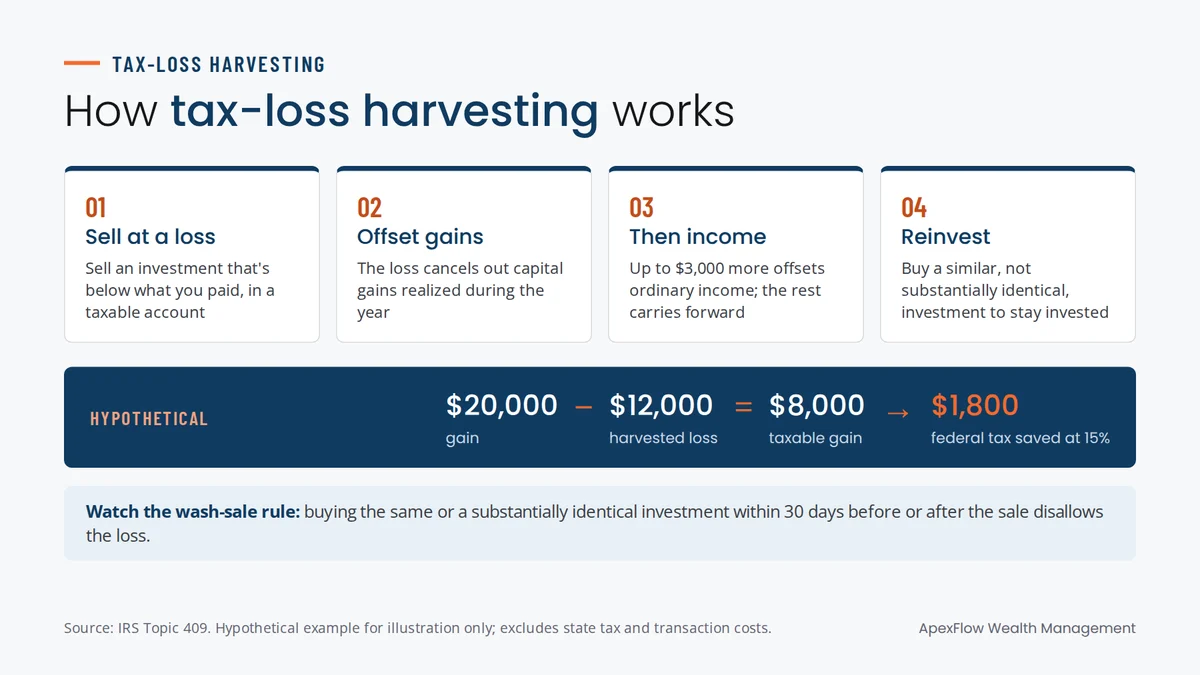
Yes, and we discuss this in depth in our article Tax-Loss Harvesting: How It Works and How to Avoid the Wash-Sale Rule. (https://apexflowwealth.com/tax-loss-harvesting/)
Talk it through with us
If a recent downturn has you second-guessing your plan, that instinct is worth talking through rather than acting on alone. Book a 20-minute Fit Call. It’s virtual, no prep is needed and there’s no obligation.

Investing involves risk and you may incur a profit or loss regardless of strategy selected, including diversification and asset allocation. The S&P 500 is an unmanaged index of 500 widely held stocks that is generally considered representative of the U.S. stock market. Keep in mind that individuals cannot invest directly in any index, and index performance does not include transaction costs or other fees, which will affect actual investment performance. Past performance is not indicative of future results. Raymond James and its advisors do not offer tax or legal advice.
Related Articles
Dig deeper into our resource library
-
 October 7, 2026
Tax-Loss Harvesting: How It Works and How to Avoid the Wash-Sale Rule
No one likes seeing an investment lose value. But in a taxable account, a loss can have a silver lining. Tax-loss harvesting means selling anRead more -
 October 7, 2026
Using Utah’s my529 Plan as a Grandparent
Helping pay for a grandchild’s education is one of the most meaningful gifts a grandparent can give. It’s also one of the most tax-efficient. Utah’sRead more -
 October 7, 2026
How to Build a Retirement Budget That Lasts
For decades, your budget had a built-in safety net: the next paycheck. Retirement changes that. Your income now comes from Social Security, maybe a pension,Read more