

At a glance
- In the first two weeks only a few things are urgent: death certificates, Social Security, and keeping bills paid and income arriving.
- Many assets pass outside probate through joint ownership, beneficiary designations and payable-on-death or transfer-on-death registrations.
- In Utah, if what your spouse owned alone is worth $100,000 or less after liens, a small estate affidavit can often collect it once 30 days have passed, though it cannot transfer a house or land.
- Your tax filing status changes over the next two years, and single brackets can raise income tax and Medicare premiums on a similar income.
- Decisions about the house and investments can usually wait six months to a year, and waiting tends to leave more options open.
When a spouse dies, the paperwork arrives long before the grief settles. The financial checklist after losing a spouse is shorter in the first weeks than most people fear. A handful of tasks protect your income and prevent problems. Most of the rest can wait until you have the energy for it, and the largest decisions are usually better made later.
Keep one notebook for every call: the date, who you spoke with and what they said. If a trusted family member offers to help, let them make calls while you make the decisions.
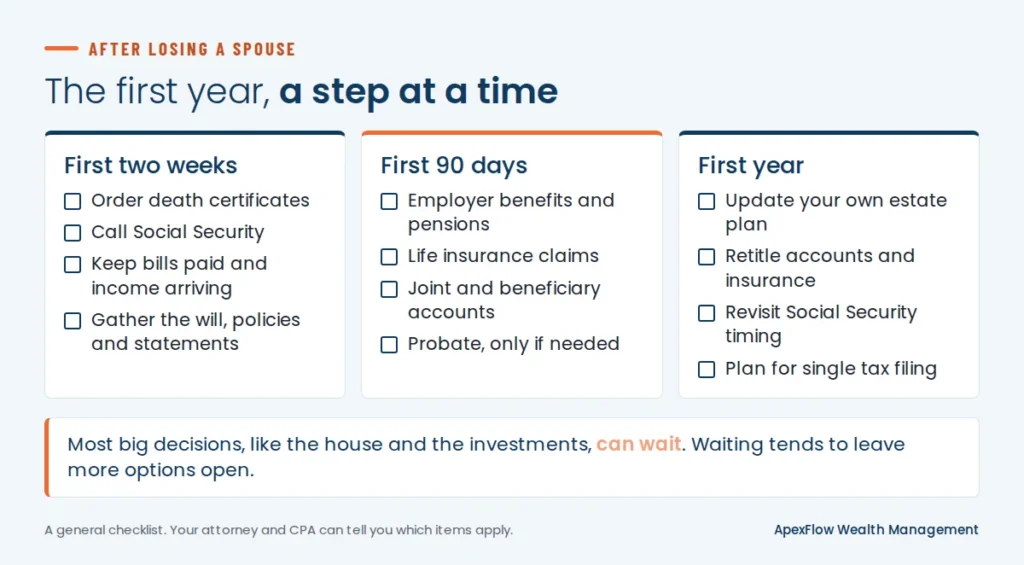
Financial checklist after losing a spouse: the first two weeks
Order death certificates. The funeral home usually orders certified copies for you. In Utah they are issued by the Office of Vital Records and Statistics in Salt Lake City and by many local health departments. Only close family or a legal representative can order them. As of July 2026, the state charges $35 for the first certified copy and $10 for each additional copy of the same record ordered at the same time. Count the places that will want one: each insurer, bank, brokerage, retirement plan and pension, plus the county recorder for real estate.
Notify Social Security. Funeral homes generally report the death. You still need to call Social Security (1-800-772-1213) to apply for survivor benefits, which cannot be started online, and to ask for the one-time $255 death payment, which must be requested within two years. If your spouse received benefits by direct deposit, the payment that arrives the month after death covers the month of death and must be returned; ask the bank to send it back.
Keep money moving. A joint checking account usually stays available to you, while accounts in your spouse’s name alone may be frozen until the right paperwork is in place. Keep paying the mortgage, insurance and utilities, and do not let homeowner’s or auto coverage lapse.
Gather documents. Locate the will or trust, insurance policies, recent statements and the last two tax returns, then set them aside for now.
The first 90 days
Employer benefits and pensions. If your spouse was working, ask the employer about the final paycheck, group life insurance, deferred compensation, stock awards and the 401(k). If your health coverage came through your spouse’s job, COBRA generally lets you and your dependents keep it for up to 36 months, and the election window is usually 60 days from the notice. If your spouse had a pension, the survivor option chosen at retirement decides whether payments continue. Utah public employees and retirees should call Utah Retirement Systems.
Life insurance claims. Each insurer needs a claim form and a certified death certificate. Look for employer and older association policies too. Proceeds paid to you as beneficiary are generally not taxable income, though interest the insurer adds is. There is no deadline to invest the money.
Joint, POD/TOD and beneficiary accounts. Joint accounts with right of survivorship become yours with a death certificate. Bank accounts marked payable on death and brokerage accounts registered transfer on death go to the named person the same way. Retirement accounts follow the beneficiary form. For a Utah home you owned as joint tenants, the survivor records an affidavit with a certified death certificate at the county recorder’s office.
Inherited retirement accounts. As your spouse’s IRA or 401(k) beneficiary, you have more options than any other heir, and the right one depends on your age. Our article on the inherited IRA 10-year rule explains them. There is rarely a reason to move or cash out the account in the first few months.
When probate is needed in Utah
Probate deals only with what your spouse owned alone, with no joint owner, beneficiary or trust. For many couples that is nothing, and no probate is needed.
- A small estate: If the estate is worth $100,000 or less after liens, at least 30 days have passed, and no one has applied to be personal representative, the person entitled to the property can collect it from banks and others with a small estate affidavit under Utah Code 75-3-1201. The affidavit cannot transfer real estate. Up to four vehicles or boats can be retitled through the Division of Motor Vehicles by affidavit.
- Informal probate: Most Utah estates that need probate use informal probate, filed in the district court of the county where your spouse lived. A surviving spouse often has priority to serve as personal representative. The application can be filed once five days have passed and generally within three years of the death, and court involvement is limited.
- Assets in a revocable trust pass through the successor trustee without probate.
If there was no will, our article on dying without a will in Utah explains who inherits under Utah law.
Utah has no estate or inheritance tax, and the federal exemption is $15 million per person for 2026, so most families owe none. Even so, filing a federal estate tax return can preserve your spouse’s unused exemption for your own estate, an election called portability; estates not otherwise required to file have up to five years under a simplified IRS procedure. Your attorney can say whether it is worth doing.
Step-up in basis on what you inherit
Assets included in your spouse’s estate generally receive a new cost basis equal to their value on the date of death. For property you owned jointly as spouses, half the value is included in your spouse’s estate regardless of who paid for it, so typically only that half is stepped up. Utah is not a community property state; in the nine states that are, both halves of community property can be stepped up. Assets your spouse owned alone receive a full step-up, and retirement accounts receive none. For a jointly owned home bought for $200,000 and worth $700,000 at death, the survivor’s basis would be roughly $450,000. Ask each custodian for date-of-death values now.
Taxes in the year of death and after
The year of death. If you do not remarry before December 31, you can file a joint return for that year, with joint brackets and the joint standard deduction of $32,200 for 2026.
The next two years. Qualifying surviving spouse status keeps joint brackets and the joint standard deduction for two more years, but only if a dependent child or stepchild lives with you, you pay more than half the cost of the home, and you have not remarried.
After that. Without a dependent child, you generally file as single starting the year after the death. For 2026, the single standard deduction is $16,100 and the 22 percent bracket ends at $105,700 of taxable income, half the joint figures. Income rarely falls by half: the larger Social Security benefit continues, and RMDs continue on the combined IRAs. More of the same income lands in higher brackets, a pattern sometimes called the widow’s penalty. A survivor 65 or older also goes from two $6,000 senior deductions (available 2025 through 2028) to one, with the phase-out starting at $75,000 of modified adjusted gross income instead of $150,000. A CPA who knows your situation is worth involving for the first two returns.
Medicare premiums. Social Security sets the Medicare surcharge based on income from two years earlier. The death of a spouse counts as a life-changing event, and Form SSA-44 asks Social Security to use a more recent, lower income. Going forward, the single threshold of $109,000 for 2026 is half the $218,000 joint threshold, so a smaller income can trigger a surcharge.
The first year: rebuilding your own plan
Update your own estate plan. Your will or trust, financial power of attorney and health care directive probably name your spouse, and each needs a new agent, trustee or personal representative. So do the beneficiary designations on your IRA, 401(k), life insurance and payable-on-death accounts. Our estate planning checklist helps with that review.
Retitle and tidy. Move accounts into your name or your trust, update the deed and insurance, close credit cards that were in your spouse’s name alone, and notify the credit bureaus.
Revisit Social Security timing. You receive the higher of your own benefit or the survivor benefit, not both. If you have not claimed yet, you may be able to take one at a reduced rate and switch to the other later, such as a survivor benefit at 60 and your own at 70. Our article on Social Security claiming strategies for married couples explains the survivor rule.
Watch for scams aimed at recent widows and widowers
Obituaries and public court filings tell scammers who to call. Common versions: fake funeral home staff demanding payment, collectors for debts that do not exist, urgent investment pitches, and new acquaintances who steer talk toward money. A few habits protect you:
- Verify any request by calling a number you already have, not one from the call, text or email.
- Never pay by wire, gift card or cryptocurrency.
- Leave birth dates and home addresses out of the obituary.
- Before paying any debt, ask the estate attorney. You are generally not personally responsible for debts in your spouse’s name alone; exceptions include joint accounts, loans you co-signed, and some family expenses under state law.
When to make the big decisions
Selling the house, moving closer to children, changing investments, making large gifts: these can almost always wait. Grief affects judgment, and it takes about a year of bills to see what one household actually spends. Waiting a year rarely closes doors. A surviving spouse who has not remarried can still use the $500,000 home sale exclusion on a qualifying sale within two years of the death. For the longer view on the house, see our article on leaving a home to your kids without a fight.
Hypothetical example: Linda, 71, lives in Logan. Her husband Ray dies in March. Their checking account, home and brokerage account were joint, and Ray’s IRA named Linda as beneficiary. In the first two weeks she orders ten death certificates, the funeral home reports the death, and her daughter sits with her on the call to Social Security, where Linda’s own $1,600 monthly benefit is replaced by Ray’s $2,800. Over the next 90 days she records the joint tenancy affidavit for the house, moves the brokerage account into her name with date-of-death values noted, and leaves Ray’s IRA in place for now. With nothing in Ray’s name alone, no probate is needed. She files jointly for the year, and her CPA shows her that from the next year the same income will be taxed on single brackets. She decides to stay in the house through the winter and revisit the question in a year. The figures are hypothetical and do not represent any client.
Where we come in
When a client loses a spouse, we begin by separating what needs attention now from what can wait, then work alongside the family’s attorney and CPA on transfers, claims and taxes. Later in the first year we rebuild the plan around one household in the Adjust with Intention step, as described on our estate planning page.
Frequently asked questions
Count every institution that will need one: insurers, banks, brokerages, retirement plans, a pension, and the county recorder for real estate, then add a few. As of July 2026, additional copies of the same record cost $10 each when ordered with the first.
Not if everything was joint, held in a trust or had a named beneficiary. If the estate is $100,000 or less after liens and includes no real estate, a small estate affidavit can usually be used after 30 days; otherwise most families use informal probate.
Yes, as long as you do not remarry before the end of the year. For the next two years, qualifying surviving spouse status keeps joint rates only if you have a dependent child living with you; otherwise you file as single.
If your spouse’s benefit was larger, you can generally receive it in place of your own. You receive the higher of the two, not both, and if you have not claimed yet you may be able to take one first and switch to the other later.
Talk it through with us
Every situation is a little different. If you want to talk through yours, book a 20-Minute Fit Call with one of our advisors, by video or in person. No prep and no obligation. Want to see how we work first? Start with the Purposeful Planning Process or our services.

The information in this article is general in nature and is not a recommendation for any individual. Consider your own circumstances or speak with an advisor before acting on it. Any opinions are those of the author and not necessarily those of Raymond James.
ApexFlow Wealth Management does not provide tax or legal advice. Please consult your tax or legal professional before acting on any strategy mentioned here.
Examples labeled as hypothetical are for illustration only. They are not based on any actual client and do not represent actual or expected results.
Related Articles
Dig deeper into our resource library
-
 October 29, 2026
The Inherited IRA 10-Year Rule: What to Do When You Inherit an IRA or 401(k)
Most people who inherit an IRA or 401(k) now have ten years to empty it, and many must also withdraw something every year. How the rules sort beneficiaries, what spouses can do, and how to spread the tax.Read more -
 November 5, 2026
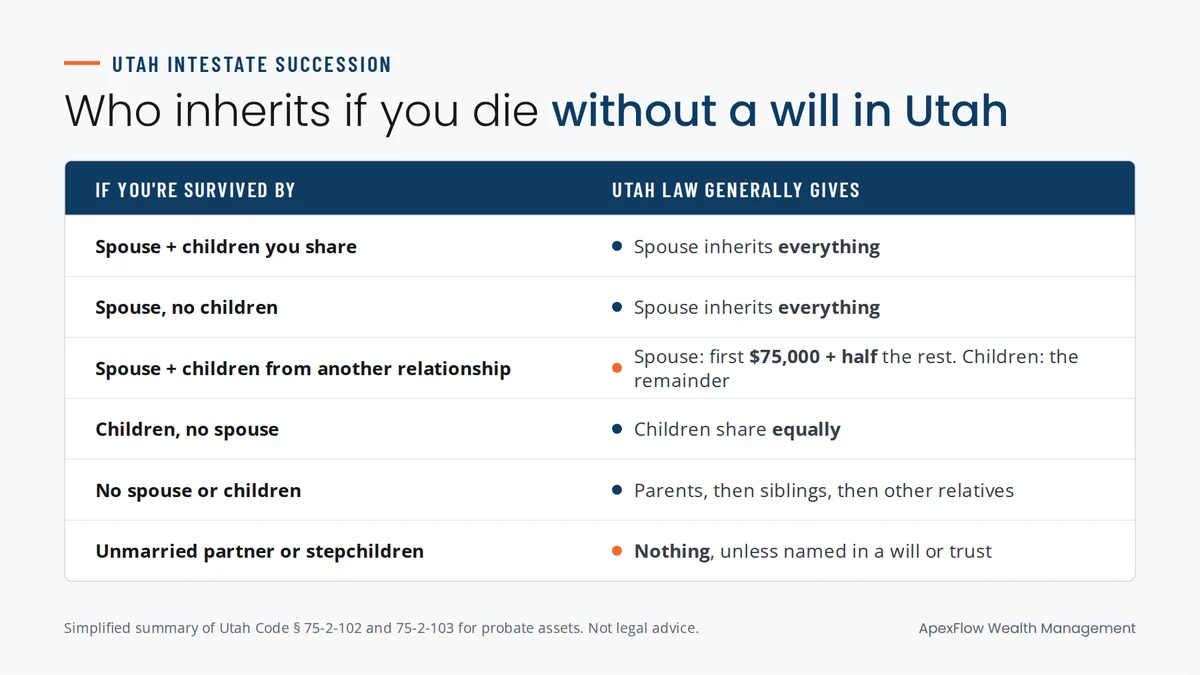
What Happens If You Die Without a Will in Utah?
Ask someone why they haven’t written a will, and you’ll rarely hear “I don’t think it matters.” You’ll hear “I haven’t gotten to it yet.”Read more -
 November 5, 2026
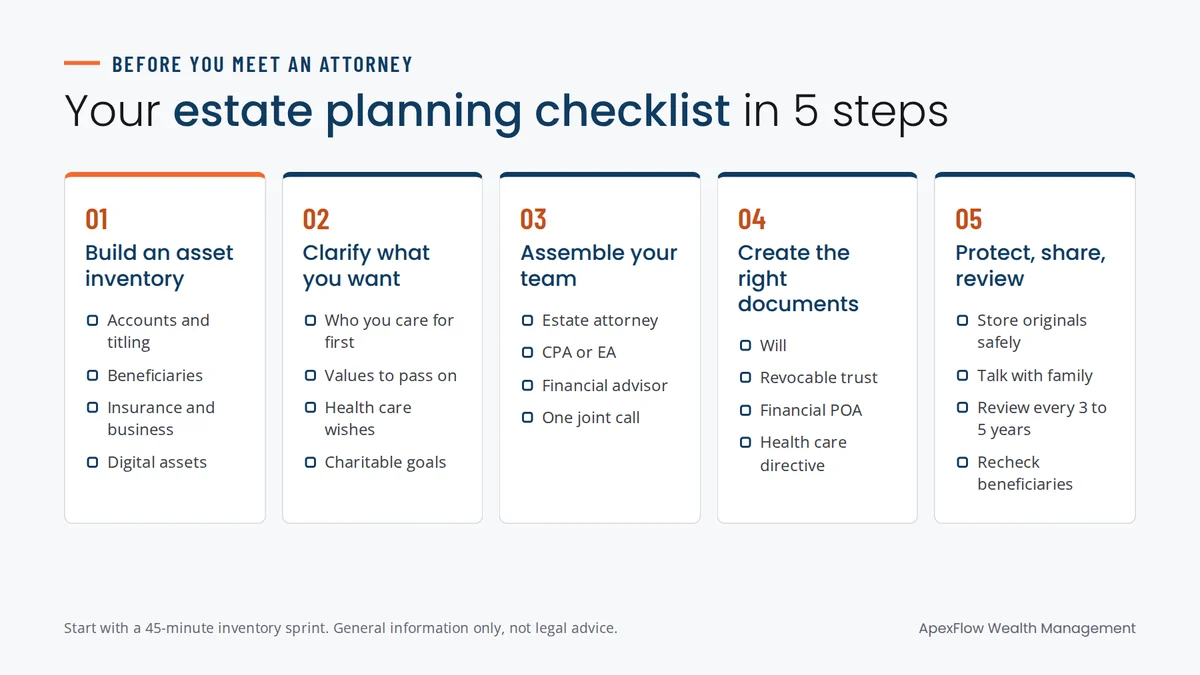
Utah Estate Planning Checklist: 5 Steps Before You Meet an Attorney
A Utah estate planning checklist comes down to the same five steps families everywhere use. List what you own, where it’s held and how it’sRead more